


"Week six of C25K and my little toe was wrecked. Missed four runs in a row, which for me is usually how the whole thing quietly dies. I'd assumed feet just toughen up eventually — turns out nobody tells beginners that isn't really true. Bought these mostly out of frustration. Been running four weeks straight since, no breaks. First time I've ever strung a month together."
Blister Slides (Running)
Blister Slides (Running)
Excellent 4.7 | 10,242 Reviews

Mark Ellison
★★★★★
I only take them off in the shower now. After two years of taping my toes before every long run and having it fall apart by mile eight, these just stay put. First marathon block I've got through without missing a session because of my feet.
Couldn't load pickup availability


Less than 1% of customers claim our Money Back Guarantee. If you're not 100% satisfied, you can trust in our 30-Day money back guarantee.
Description
Hotspot on your little toe by mile four? Taping five toes before every run? Two thirds of blisters form on the toes — the one part of your foot nothing is built for:
- One piece covers all five toes
- Your shoe rubs the sleeve, not your skin
- Gel cushions toe tips on descents and hard stops
- Thin enough that your shoes still fit
- Ventilated, so sweat gets out
- Goes on in seconds — no taping ritual
- Reusable — wash it and wear it again
- 30-Day Satisfaction Guarantee
Size Guide
Choose by your usual shoe size. If you're between sizes, take the larger one.
| Size | Women's US / UK |
Men's US / UK |
Length A | Width | Length B | Gel |
|---|---|---|---|---|---|---|
| S | 4–6 / 2–4 | 2–3 / 1–2 | 9.5 cm 3.74 in |
7.5 cm 3.15 in |
8 cm 3.15 in |
0.3 cm 0.12 in |
| L | 6.5–11 / 4.5–9 | 3.5–8 / 2.5–7 | 10 cm 3.94 in |
9 cm 3.54 in |
8.5 cm 3.35 in |
0.3 cm 0.12 in |
| XL | 11.5–15 / 9.5–13 | 8.5–12 / 7.5–11 | 10 cm 3.94 in |
10 cm 3.94 in |
8.5 cm 3.35 in |
0.3 cm 0.12 in |
Length A = across the toebox. Width = around the forefoot. Length B = front to back. All sleeves have the same 3 mm gel layer.
Care & Wash Guide
Premium Materials Certified
30-Day Satisfaction Guarantee


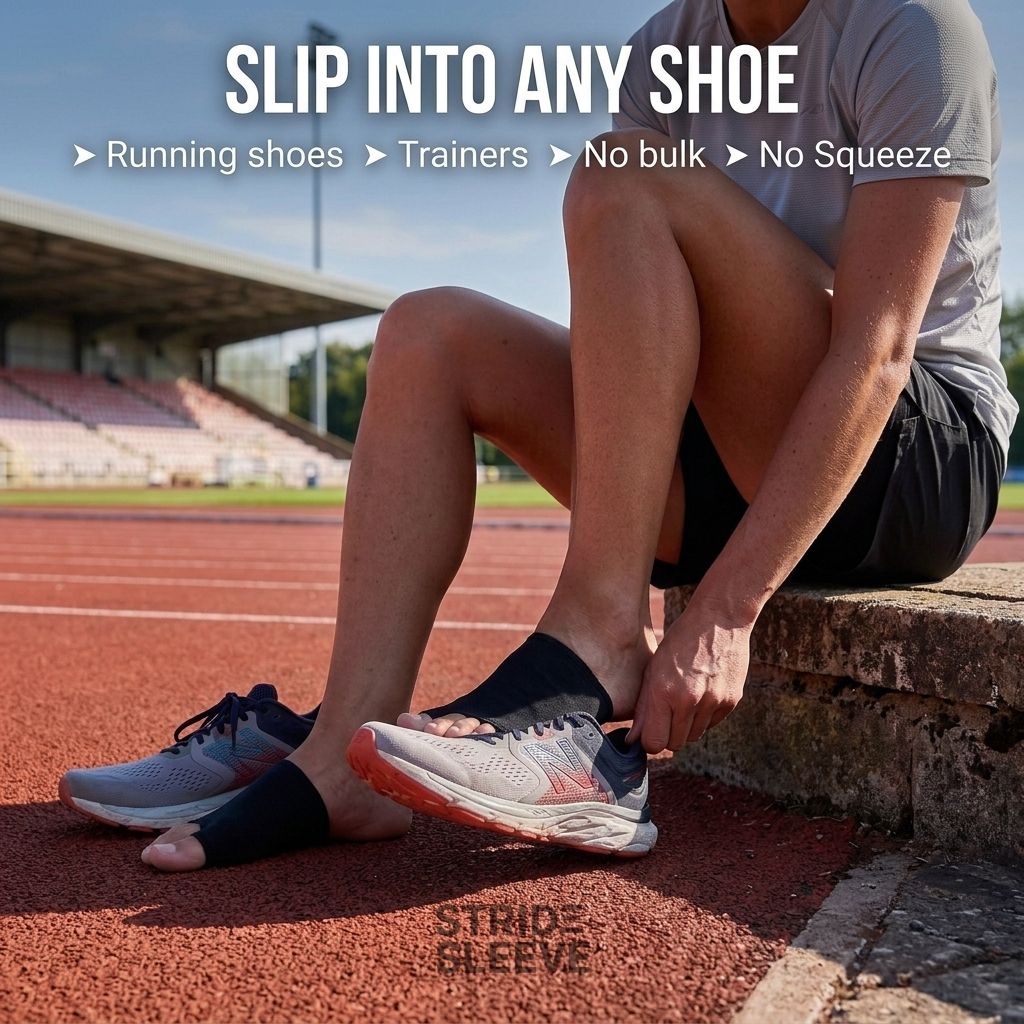
Stride Sleeve Blister Protectors
Designed in a way, that:
Reduces friction
The inner layer stays with your skin while the outer layer slides against your sock. Your shoe rubs the sleeve instead of you.
Wicks moisture away
Ventilated rather than sealed, so sweat has somewhere to go. Damp skin blisters more easily than dry skin — this keeps it moving.
Gentle compression
A close, even fit that stays put through a full session. No slipping, no bunching, nothing to stop and adjust mid-run.
Customer Reviews
★
★
★
★
★
4.7 | 10,242 Reviews
Blisters start where friction happens.
Two thirds of blisters form on the toes — the part of your foot that takes the most impact on every sprint, turn and descent, and the part nothing is built to protect.

1
BIG TOE
Push-off and quick turns drive the hardest friction through the largest toe.
2
OUTER TOES
The fifth toe sits against the shoe wall — one of the most common blister sites of all.
3
TOE TIPS
Braking and descending ram the toes into the front of the shoe. Pressure, not rubbing.
Stride Sleeve covers all three in one piece — so the shoe rubs the sleeve, not your skin.
| Stride Sleeve | Regular Socks | |
|---|---|---|
| Covers all five toes at once | ||
| Sits between toe and shoe | ||
| Shoe rubs the sleeve | ||
| not skin | ||
| Ventilated — sweat escapes | ||
| Protects on braking and descents | ||
| Thin enough that shoes still fit | ||
| Reusable — wash and repeat |

Developed & Validated by Foot Care Specialists
Stride Sleeve combines a one-piece toebox design with clinical input on how blisters actually form.
To make sure it holds up outside a clinic, we worked with Dr. Sarah Whitfield, a practising podiatrist who has worked race medical tents for over a decade.
- Built on the science of shear and pressure
- Tested by real runners, hikers and players
- Refined over successive wear-test rounds
Is it normal to get blisters this often? Am I doing something wrong?
You're not. Around two thirds of blisters form on the toes, and it happens to beginners and experienced athletes alike — new shoes, unconditioned skin and rising distance all at once is simply a lot to ask of your feet.
It's also worth knowing that roughly half the runners treated for blisters at one marathon medical tent had never blistered once in training. It isn't a sign you're doing it wrong.
Won't my feet just toughen up eventually?
Some skin does adapt over time. But blisters are caused by shear — layers of skin sliding against each other under load — and that force doesn't go away because you've been running longer.
Waiting it out also has a cost. Foot blisters are linked to a notably higher chance of picking up another training injury, most likely because people change how they walk or land to avoid the sore spot.
How do I know which size to order?
Go by your usual shoe size using the chart in the Size Guide above — S, L or XL, with women's and men's sizes listed in both US and UK.
If you're between two sizes, take the larger one. And if it isn't right when it arrives, message us and we'll sort it.
Will it fit inside my shoes or boots?
Yes. The gel layer is 3 mm, and the whole thing is built to sit under a normal sock without taking up the toe box space it's meant to protect.
This is the main reason it's one piece across all five toes rather than separate caps. Stacking individual caps on multiple toes crowds the shoe and can create a new problem — which is exactly what we designed around.
How does Stride Sleeve actually work?
It sits between your toes and your shoe. The inner surface stays put against your skin; the outer surface slides against your sock.
So the rubbing still happens — it just happens to the sleeve instead of to you. The gel layer also cushions the toe tips when your foot is driven forward on braking and descents.
I already wear grip socks. Isn't that the same thing?
Different problem. Grip socks stop your foot sliding around inside the shoe, which is real and worth having.
They don't do anything about the shoe pressing directly on your toes — the grip sock industry says as much itself. That's a pressure problem, not a slippage one, and it's the one this is built for.
Won't it make my feet sweat more?
This is the right question to ask, because most gel products are sealed — which is why their own instructions tell you to air-dry your feet and take them off for a few hours a day.
That matters beyond comfort: damp skin blisters more readily than dry skin, so a sealed protector can end up causing what it's meant to stop. Ours is ventilated so moisture has somewhere to go.
Does it work for running, hiking and football?
Yes — the mechanism is the same wherever your toes meet the front of your shoe. Runners tend to notice it most on long descents, hikers on consecutive days, footballers on turf where the boot is tight by design.
It also works for padel, tennis, walking holidays and long days on your feet at work.
How long does a pair last?
It's reusable — rinse it in cool water after each session and air dry it flat. Most people get months of regular use from a pair.
Plenty of customers keep a second pair in their kit bag so there's always a dry one ready.
How long does delivery take?
Orders typically arrive within 6–9 working days, worldwide.
If you're buying for a specific race or trip, order at least two weeks ahead so you've time to wear them in on a training session first.
What's your returns policy?
If you're not completely satisfied, contact us within 30 days of delivery for a full refund or exchange.
See Why 500,000+ Satisfied Customers Trust Stride Sleeve
4.7 out of 5
★★★★★
Based on reviews from 500,000+ customers
Daniel R.
Verified Buyer
★★★★★
3 days ago
Week six of Couch to 5K and my little toe was in bits. Missed four runs in a row, which is normally how the whole thing quietly dies for me. I'd assumed feet just toughen up eventually — nobody tells beginners that isn't really how it works. Got these out of pure frustration. Four weeks straight since, no missed sessions. First time I've ever strung a month together.
Marcus T.
Verified Buyer
★★★★★
4 days ago
First half marathon. Sixteen weeks of training and not a single blister, so I genuinely didn't think about my feet at all. A mate who's done a few told me race day is different — faster, hotter, water going everywhere from the stations. Wore these on the day. Came in at 1:58 and there was nothing on my feet afterwards. Least dramatic part of the whole morning.
Angela W.
Verified Buyer
★★★★★
5 days ago
Walked the Camino Francés in May. I'd read about forty forum threads about blisters and every single one said something different — Vaseline, wool socks, two pairs of socks, a needle and thread apparently. I didn't want to be working it out on day three with 500km left. Wore these from Saint-Jean. Thirty-one days, no blisters, finished the whole thing. Two years of planning and this was the bit I was most scared of.
Ryan K.
Verified Buyer
★★★★★
6 days ago
I've got three pairs of grip socks. My heel's been fine ever since I got them — my little toe was still wrecked after every Sunday game. Turns out grip socks sort out your foot sliding in the boot, they do nothing about the boot pressing on your toes. Two different problems. Nobody told me that. These sit under the sock and the toe thing has just stopped.
Paul H.
Verified Buyer
★★★★★
1 week ago
Came back to running after eighteen months off with a knee problem, so I was paranoid about anything at all going wrong. Third week back I had a hotspot on the outside toe and caught myself landing differently to avoid it — which is exactly how you end up injured again. These went on and it stopped being a thing. I don't check my feet after runs anymore.
Susan M.
Verified Buyer
★★★★★
1 week ago
Bought these for my husband before our walking holiday in the Lakes. He's stubborn about gear and made a face about it. Day two he was the only one of the four of us not sitting outside the pub with his boots off. He's since bought a second pair himself, which from him is basically a five star review.
Tom B.
Verified Buyer
★★★★★
1 week ago
Sunday league. I was the bloke taping his toes in the car park before every game, which takes about ten minutes and falls apart by half time anyway. These go on in five seconds and stay put for ninety minutes plus extra time. Boots still fit properly, which was my main worry — they're tight for a reason.
Chris D.
Verified Buyer
★★★★★
2 weeks ago
Trail marathon with a lot of descending. Every long downhill section I'd feel my toes hitting the front of the shoe and I'd lose two toenails a season like clockwork. This is the first race I've finished where I didn't immediately check the damage. Whole season so far and toenails all present and correct.
Hannah P.
Verified Buyer
★★★★★
2 weeks ago
New boots two weeks before a walking trip, which I now know is a terrible idea. First proper training walk left me hobbling and I panicked a bit about the trip. Wore these for the break-in walks and the trip itself and got away with it completely. Wish I'd known about them before I bought the boots, honestly.
Michael G.
Verified Buyer
★★★★★
3 weeks ago
Padel three times a week. By the third set I wasn't going for balls on my left because I knew what stopping was going to feel like, then I'd be walking round the office carefully on Monday. Bought better shoes twice trying to fix it. Wasn't the shoes. Played a full two hours on Saturday and moved the same in the last game as the first.